

Hawaii benefit applications do not all go through the same account. Food and cash assistance, Med-QUEST, child care, island energy assistance and unemployment have different intake and follow-up routes. Start with the expense you need help with, then keep the receipt and next required task for that particular program.
Reviewed October 22, 2026. This independent guide explains official application routes and common decision points. It cannot determine your eligibility or reserve funding. A dated agency notice about your own case takes priority over a general summary.
Match your need to the next task
| Need | Starting route | What to confirm next |
|---|---|---|
| Groceries | DHS SNAP application through PAIS or a processing center | Application receipt, interview and requested verification |
| Medical coverage | Med-QUEST and KOLEA | Coverage category and the renewal date on your notice |
| Children and work | DHS child care application; FTW worker for assigned activities | Correct CCS or POD program and approved provider |
| Electricity emergency | Community Action Agency serving your island | Crisis intake, documents and available monthly funding |
| Rent or job loss | The housing authority serving your location; Hawaii UI separately | Waiting-list status or the next claim certification |
For example, a parent may need to submit a SNAP interview document to DHS, a medical renewal through KOLEA, and an electricity shutoff notice to an island agency. Completing one task does not tell the other offices that the remaining tasks are finished. Keep separate confirmation records even when the same pay statement supports several applications.
SNAP and WIC: use Hawaii’s own food-assistance routes
The DHS SNAP page links to the current Hawaii income and benefit tables, including tables effective October 1, 2026. Hawaii figures differ from the standard tables for the contiguous states. Gross income, net income and broad-based categorical eligibility are different tests; do not treat every column as an additional limit that every household must pass.
Apply through PAIS or follow DHS’s signed paper application and processing-center instructions. Save the application tracking number, then watch for an interview and verification request. If the online service fails to load, use the official alternate route rather than submitting repeated online applications without knowing which one was received. Tell DHS if you have an urgent food shortage so it can assess the applicable processing rules.
WIC requires a separate clinic contact
Hawaii WIC serves eligible pregnant, breastfeeding and postpartum participants, infants and children younger than five. It includes nutrition services as well as specified foods. Contact a WIC clinic for an appointment and the records needed for its assessment. A SNAP application does not schedule that appointment, and an adult’s SNAP work-rule question does not establish a child’s WIC eligibility.
Med-QUEST: distinguish a future review from a current closure
Use KOLEA for the medical-benefits account and follow Med-QUEST instructions for applying, updating contact details and responding to renewals. Keep the medical case number separate from a PAIS food or cash tracking number. If your income or family situation changes, ask which coverage category should be evaluated rather than assuming one adult program represents all Medicaid coverage.
The current Stay Well, Stay Covered guidance describes 2027 activity requirements and more frequent renewals for certain adults, with exceptions. Its detailed guidance tells affected members about showing a qualifying month within the six months before their renewal. It does not say that every member loses coverage on January 1. Informational outreach alone is not an instruction to upload new work proof immediately; Med-QUEST will explain when evidence is required.
Continue answering ordinary notices now. For a 2027 renewal, identify the review date, the months the agency is examining and whether an exception applies before gathering activity records. Children, pregnancy-related coverage and disability-related categories should not be treated as interchangeable with the affected adult group.
TANF, TAONF and First-To-Work
DHS family assistance includes federally funded TANF and state-funded TAONF for qualifying families who do not qualify for the federal program. The agency determines which rules apply to the family. Neither program is a general cash payment to every low-income adult.
Ask about prior months of assistance, the program’s lifetime limit, and First-To-Work responsibilities or exceptions. The official page describes a 60-month lifetime limit and employment-related services, but eligibility depends on more than the presence of a child. Its financial standard is not simply the current SNAP poverty chart, so copying a SNAP income figure into a cash-benefit calculation can produce a wrong answer.
If assigned to First-To-Work, clarify the activity plan and request information about transportation or child care connected to participation. Write down who authorizes a service before committing to an expense. A supportive service is not necessarily an extra unrestricted cash award.
CCS and Preschool Open Doors are different programs
The child care subsidy page distinguishes Child Care Subsidy, generally connected to work, school or training, from Preschool Open Doors. POD does not have the same parent-activity requirement. Check the current POD program year and your child’s birth date; do not assume an old spring-only announcement describes every current application window.
Use the official child care application and select the appropriate program. Save its tracking number before leaving the session. Upload all required verifications before submitting. For later documents or corrections, contact the responsible program instead of creating another application.
Before selecting care, confirm provider approval, an available place, authorized dates and hours, and any family share. An application receipt is not permission for a provider to bill the subsidy. If you need care for an assigned work activity, ask the worker how that activity and the child care authorization connect.

Choose the follow-up route from the application’s actual stage
Editorial analysis. Before starting another child-care application, identify whether the family has an unfinished draft, a submitted request awaiting a decision or an active CCS case needing a change. The public instructions explicitly tell active CCS families and families awaiting a decision not to create another application for those tasks. First-To-Work participants are directed to their case manager instead.
For an unfinished application, keep the tracking number and use the continuation route. For a submitted request, prepare a short message identifying the program, tracking number, missing or corrected document and the instruction being answered. Ask the appropriate CCS or POD contact how to deliver it and retain the response. Do not assume a file stored on your device has reached the program. Separately confirm the provider, care dates and family responsibility; correcting a document does not itself authorize a start date.
Public-guidance check, October 23, 2026: we read the official application landing page and the public pre-application instructions. We stopped before CAPTCHA or application entry and did not submit, continue or change a case.
H-HEAP: June energy credits versus year-round crises
The H-HEAP page describes two routes. Regular Energy Credit applications are accepted June 1–30. October is therefore not an open regular Energy Credit application month under that posted schedule. Energy Crisis Intervention is available year-round for qualifying disconnection situations, subject to limited monthly approvals.
Apply only through the Community Action Agency serving your island. Sending an energy application to a DHS processing center or the state program office can delay it. The program allows one type of payment in its October–September program year, so ask how a prior award affects a new crisis request rather than assuming both payments can be combined.
For an urgent shutoff, provide the current notice and account details and ask the agency what it can accept now. Also contact the utility about its available arrangements. An assistance application by itself does not establish that a disconnection has been suspended.
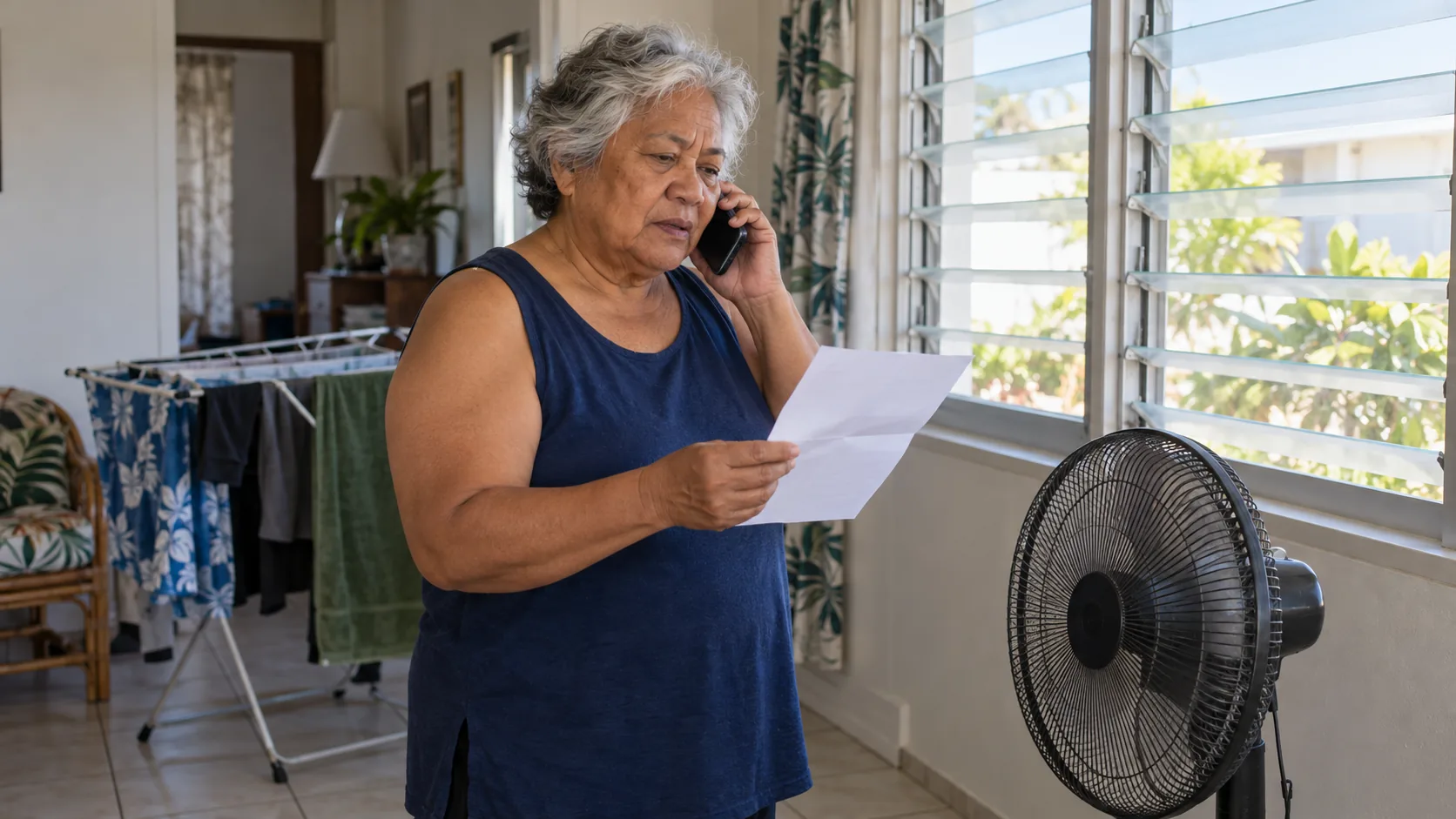
Resolve an account-name mismatch before assuming the energy packet is complete
Editorial analysis. If the utility account is in a spouse’s or another household member’s name, explain that arrangement to the island agency. The posted application packet calls for account-holder identification and a signed consent section in that situation. Keep the complete current bill, service address and any disconnection notice together; a photograph of only the amount due may omit information the checklist requests.
For a crisis request, ask what the agency can accept now and which program year any prior payment belongs to. October begins a new October–September year, but that calendar boundary does not guarantee a monthly crisis slot or reopen the June-only regular credit window. Keep the utility’s actual disconnection or payment-arrangement terms separate from the agency’s intake response. Sending documents to an ordinary DHS benefits office is not the island-agency submission the H-HEAP instructions require.
Public-guidance check, October 23, 2026: we read the H-HEAP explanation and linked application checklist. We did not verify an account holder, crisis slot, payment or utility arrangement.
Choose the housing authority for your island
HPHA’s voucher programs serve Oahu. Residents of other islands need the authority serving their county rather than assuming the HPHA voucher application covers all Hawaii. Tenant-based assistance follows an eligible household under program rules; project-based assistance is tied to particular units.
Check whether the specific list is accepting applications, which preferences apply and how to update an existing application. An announcement that a list opened on an earlier date does not prove it is still open today. A closed voucher list also does not mean every public housing or property-based opportunity is closed. Keep rent-arrears or immediate shelter requests separate from a long-term waiting-list application.
Follow your weekly or biweekly certification instructions
Start at the Hawaii unemployment office and its claimant service, not a benefits application account. Read the certification instructions and the schedule shown for your claim. Hawaii uses weekly and biweekly filing instructions; biweekly filers still submit each of the two weeks separately.
The posted deadline is seven days after the relevant Saturday, or after the second Saturday for the biweekly schedule. Save each confirmation and check the next due date. Submitted answers cannot be edited in the account; contact the agency promptly about a mistake. Missing two or more consecutive weeks requires the reopening/additional-claim process described by the office. Do not confuse a received initial claim with completed certifications for later weeks.
Keep a short, program-specific case record
Record the program, date, confirmation number, next action and deadline. When calling, ask a concrete question: Was the application received? Which document is missing? Which period must it cover? Where should it be sent? Save a copy and evidence of delivery. If a decision appears wrong, read its hearing instructions and deadline promptly; a customer-service inquiry should not be assumed to extend that deadline.
Official sources and review limits
The linked DHS, Med-QUEST, Health Department, HPHA and Labor pages support the program distinctions above. Local funding, waiting lists and individual determinations can change. Some online services can be temporarily inaccessible to automated readers; that does not establish that a visitor’s link is broken. Use the agency’s alternate contact route where necessary. For another state, use the FactBob state directory; Hawaii’s energy calendar and medical review rules should not be transferred to another state’s application.